



Quick answer: test the finished surface with the cleaners, contact modes and recovery time of the real product
Chemical resistance for appliance glass is not established by saying “glass is chemically stable.” The exposed system may include ceramic ink, organic decoration, mirror coating, anti-fingerprint layer, conductive coating, adhesive, edge seal and protective film. Each can respond differently to detergents, degreasers, descalers, alcohol, acids, alkalis, oils and repeated wiping.
An OEM should build a product-specific cleaner matrix. Define the exact chemical or commercial cleaner, concentration, temperature, contact method, duration, number of cycles, wiping material, rinse procedure, recovery time and acceptance criteria. Test production-intent panels, then examine appearance, color, gloss, haze, transmission, adhesion and any functional property. Shipment inspection should confirm that production surfaces have not been contaminated or attacked by factory cleaners.
ASTM D1308-20(2025) describes evaluating household-chemical effects on clear and pigmented organic finishes, including visible and physical changes. ASTM D2248-25 addresses detergent resistance of organic finishes and includes a historical home-appliance protocol. These are useful references for some finish systems, but their scope does not make them an automatic acceptance specification for every glass, ceramic ink or inorganic coating.
Why “chemical-resistant glass” is an incomplete claim
The float-glass substrate may remain intact while a decorative or functional layer changes. Common failure modes include:
- loss of gloss or increased haze;
- color shift or whitening;
- softening, swelling or tackiness of an organic layer;
- blistering, peeling or adhesion loss;
- pinholes or edge lifting;
- reduced hydrophobic performance;
- altered sheet resistance or display-window transmission;
- staining caused by residue rather than permanent attack;
- damage to an adhesive or seal beside the glass.
The visible symptom may also depend on the backing color and illumination. A slight haze that is invisible on a loose black panel can become obvious over a powered display. The finished product application must therefore guide inspection.
Map every exposed surface and material
Before choosing chemicals, create a surface map for the component and assembly:
| Zone | Typical construction | Main risk |
|---|---|---|
| User-facing clear glass | bare, etched, AG, AR or easy-clean surface | haze, stain, coating wear |
| Printed border/icons | ceramic or organic ink | color change, softening, adhesion loss |
| Display window | selective print/coating stack | transmission, color and readability change |
| Mirror or decorative area | metallic/dielectric or organic layer | edge corrosion, peeling, visual nonuniformity |
| Bonding perimeter | glass/coating plus adhesive or primer | compatibility and bond loss |
| Cut edge or hole | exposed glass and coating termination | chemical ingress or edge staining |
Record which face the consumer cleans, which face the assembler handles and which zones can contact condensation, grease or detergent leaks. This prevents a test plan from focusing only on the central viewing area.
Build a cleaner matrix from customer requirements
Start with the appliance manual, target-market habits and known installation environment. Do not select aggressive laboratory reagents only because they are easy to source. A useful matrix may include:
- neutral dishwashing detergent;
- kitchen degreaser;
- glass cleaner containing alcohol or ammonia, if allowed;
- diluted acetic or citric acid for scale removal;
- alkaline cleaner used in the target market;
- chlorine-containing cleaner only if reasonably foreseeable;
- cooking oil, coffee, tea, milk or cosmetics for relevant products;
- the factory’s own cleaning and fingerprint-removal fluids;
- approved adhesive remover used during rework.
Commercial formulations change, so record brand, product name, lot where practical, safety-data revision and dilution. If the customer specifies a chemical class rather than a brand, define a controlled representative formulation.
Separate accidental contact from repeated cleaning
One test cannot represent every use pattern. Use several exposure modes:
Spot or covered exposure
A measured liquid volume is placed on the surface, optionally covered to reduce evaporation. This models a spill or a cleaner left in contact. Define droplet area, cover material, temperature and time.
Immersion or edge exposure
This may be useful for evaluating a coating system, exposed edge or small coupon, but it can be more severe than normal consumer use. ASTM D870-25 covers water immersion of coated specimens and explicitly treats it as a comparative approach rather than a stand-alone service-life prediction.
Repeated wipe cycles
Apply a controlled amount of cleaner and wipe with a defined cloth, load, stroke length and cycle count. This combines chemistry with abrasion and often better represents routine cleaning.
Condensation and run-down
For washer lids, oven fascias or controls, droplets may repeatedly move toward edges and joints. Position the assembly to reproduce that path and inspect interfaces.
Factory-process exposure
Test the fluids used for washing, screen cleaning, protective-film application, label removal and rework. A consumer-safe surface can still be damaged before shipment by an uncontrolled factory chemical.
Define variables so test results are repeatable
At minimum, the protocol should state:
- specimen part number, revision, lot and coating/ink side;
- surface cleaning and conditioning before test;
- chemical identity, concentration, pH where useful and preparation date;
- applied volume or immersion depth;
- contact temperature and duration;
- open, covered or sealed exposure;
- cloth type, wipe load, speed and cycles;
- rinse fluid and drying method;
- recovery period before evaluation;
- measurement locations and reference specimen;
- acceptance limits and retest rule.
Recovery time matters. Some organic layers soften temporarily and recover; other damage continues after rinsing. Inspect at the immediate post-exposure point and again after the agreed recovery time.
Use standards as methods, not marketing shortcuts
ASTM D1308 targets household-chemical effects on clear and pigmented organic finishes. Its listed changes—such as discoloration, gloss change, blistering, softening, swelling and adhesion loss—are useful evaluation categories. However, an inorganic ceramic print or vacuum coating may require different methods and metrics.
ASTM D2248 covers detergent resistance of organic finishes and can help structure comparative testing. ASTM C650-20 addresses chemical resistance of ceramic tiles using household and cleaning chemicals; its tile scope should be acknowledged if its concepts are adapted to appliance glass.
A responsible specification states “tested according to the following agreed procedure” and identifies deviations. It should not say “ASTM chemical-proof” or imply that a method creates universal compatibility.
Establish measurable acceptance criteria
Visual approval alone can hide gradual degradation. Combine relevant measurements:
| Function | Possible measurement | Example decision format |
|---|---|---|
| Color | L*, a*, b* and color difference | maximum agreed change versus control |
| Gloss | gloss units at specified geometry | range or maximum loss |
| Clarity | haze and visible transmission | before/after limit |
| Display window | spectral or luminous transmission | range plus powered readability |
| Mirror layer | reflectance and visual uniformity | no edge attack plus numeric range |
| Easy-clean layer | contact angle or validated cleaning force | minimum retained value |
| Conductive coating | sheet resistance | maximum permitted change |
| Adhesion | agreed cross-cut, pull or tape method | rating after recovery |
Also define viewing distance, lighting, background and whether magnification is allowed. Cosmetic acceptance should be tied to zones because a defect beside a display may be more critical than one hidden behind a frame.
Evaluate printing and coating together
Screen-printed panels often use different ink colors and thicknesses on the same part. Dense black may resist a cleaner while a metallic icon or transparent window does not. Test each material family and overlap zone.
For coated glass, inspect:
- the exposed coated face;
- coating-to-print boundaries;
- coating deletion edges;
- holes and perimeter terminations;
- areas under protective film;
- surfaces touched by suction cups or fixtures;
- bonded regions after chemical exposure.
If a supplier changes ink, hardener, coating source, cure condition or cleaner, the approved result may no longer apply. Change control should identify which substitutions require partial or full requalification.
Include the complete assembly where interfaces matter
Loose-panel testing is useful for isolating a surface response, but the appliance assembly can retain liquid at a seal, create capillary paths or place stress on a softened coating. Test production-intent modules when there are adhesives, displays, sensors, frames or edge seals.
During installation preparation, control surface activation, primer, cleaning and waiting time. A cleaner residue can reduce bond strength even if no visual defect appears. Assembly trials should inspect both immediate adhesion and environmental durability.
Design factory testing and ongoing controls
Qualification testing is normally broader than routine factory testing. A production control plan may use:
- incoming certificates and lot identity for ink/coating materials;
- viscosity, mixing, cure or furnace records as applicable;
- first-piece color, gloss, transmission or resistance checks;
- a short validated solvent or cleaner rub as a process indicator;
- periodic full chemical matrix verification;
- retained samples for investigation;
- inspection of cleaning stations and approved-fluid lists;
- audit of cloths, gloves, fixtures and protective films.
A quick rub test is not equivalent to long exposure, but it can be an efficient process monitor if correlated to qualification data and used consistently.
Investigate failures by mechanism
When a panel fails, record where and how it changed. Useful questions include:
- Was the defect permanent after rinsing and recovery?
- Did it occur only under a cover where evaporation was prevented?
- Was the coating attacked, or was residue deposited?
- Did wiping abrasion contribute?
- Did failure start at an edge, pinhole or overlap?
- Was the tested sample fully cured and within shelf life?
- Did the reference panel show the same change?
- Were chemical concentration and temperature verified?
Use microscopy, color/gloss data, adhesion evaluation and material records as appropriate. Repeating an uncontrolled test with a different cloth rarely identifies the mechanism.
Prevent contamination during shipment
Shipment damage can resemble chemical failure. Plasticizers, interleaving paper, adhesive film, wood treatment, humidity and trapped cleaning residue may stain or imprint a surface. Packaging qualification should consider:
- separator compatibility with the coating;
- film adhesive and removal behavior after aging;
- moisture and temperature exposure in transport;
- clean packaging environment;
- drying time before stacking;
- no unauthorized corrosion inhibitor or cleaner;
- inspection at multiple pack positions after a transport trial.
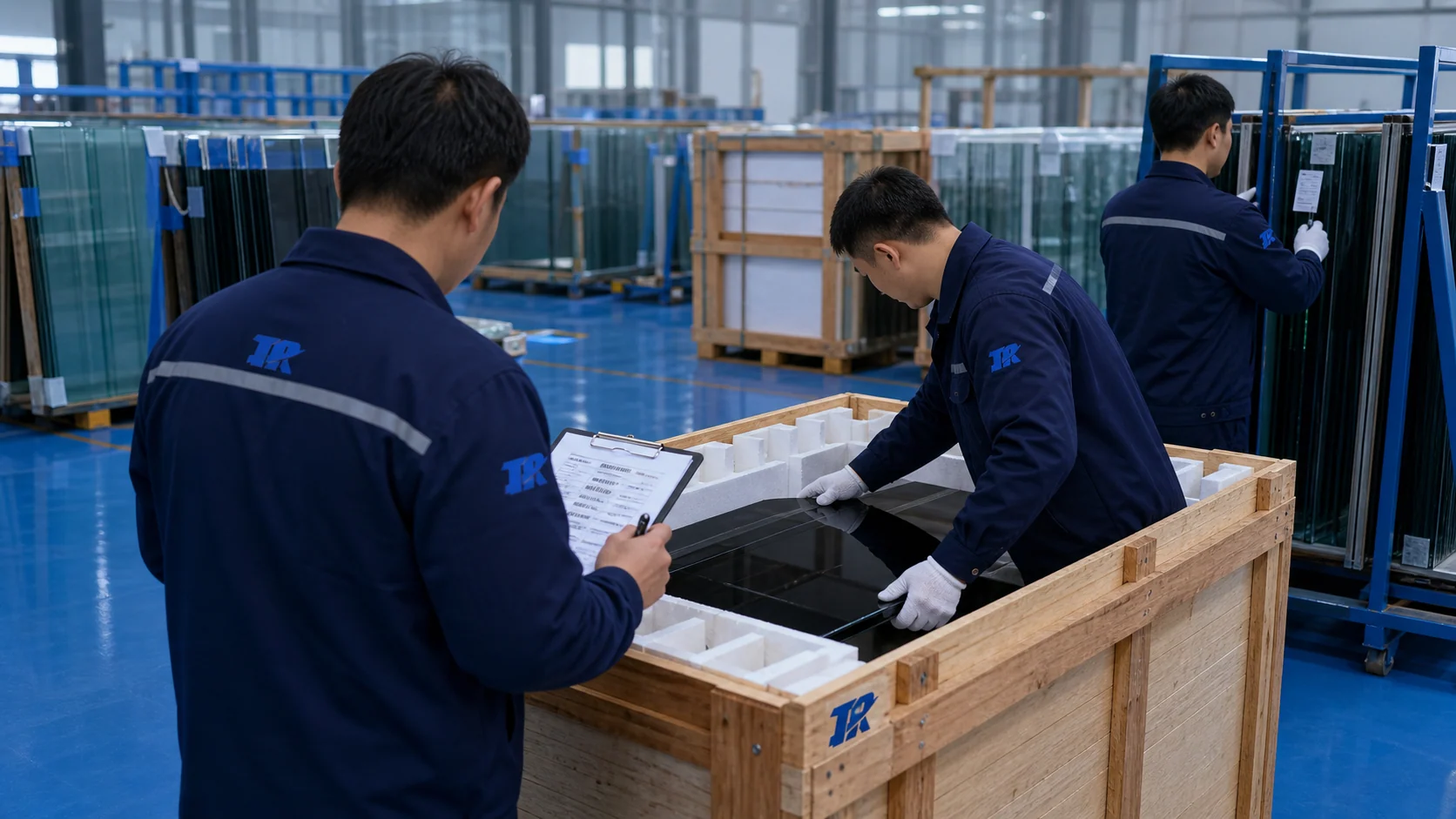
The shipment inspection record should identify packaging materials and confirm dry, clean panels before sealing.
Procurement checklist
Include the following in an RFQ or control plan:
- product application and exposed surfaces;
- substrate, ink and coating stack;
- customer-approved and prohibited cleaners;
- accidental-spill and repeated-wipe conditions;
- test temperature, duration, cycles and recovery;
- optical, cosmetic, adhesion and functional criteria;
- assembly interfaces and installation fluids;
- sample size and lot representation;
- qualification versus routine-control frequency;
- material and process change-notification rules;
- report, retention-sample and traceability requirements;
- packaging-contact materials.
This turns a vague request for “chemical resistance” into a testable agreement.
FAQ
Is tempered glass resistant to every household cleaner?
The glass substrate is generally durable against many normal cleaners, but printing, coatings, adhesives and seals may not be. Test the complete exposed material stack against the actual approved cleaners.
Is an alcohol wipe test enough?
No. It can be a useful process indicator, but it does not represent acids, alkalis, detergents, prolonged spills, repeated wiping or edge exposure.
Should a commercial cleaner be tested at full strength?
Use the manufacturer’s instructions and reasonably foreseeable misuse agreed by the product team. Record the product and dilution so the result is reproducible.
Can accelerated chemical testing prove a ten-year service life?
Not by itself. Accelerated tests compare materials under defined conditions; translating them into service life requires a validated correlation and real-use assumptions.
What should be inspected after chemical exposure?
Check appearance, color, gloss, haze, transmission, adhesion and the coating’s specific function. Inspect edges, print overlaps and bonded interfaces after the defined recovery time.
Conclusion
Reliable appliance-glass chemical testing starts with the real surface construction and use environment. Define the cleaner matrix, exposure modes, recovery, measurements and acceptance limits before qualification. Then maintain material traceability, controlled factory cleaning, periodic verification and compatible packaging. This approach protects appearance and function without making unsupported “chemical-proof” claims.
Send Tairong your glass stack, approved cleaner list and acceptance criteria for a manufacturability review. You can also review our guides to screen-print ink durability, anti-fingerprint coatings, scratch and abrasion testing and coated glass products.