
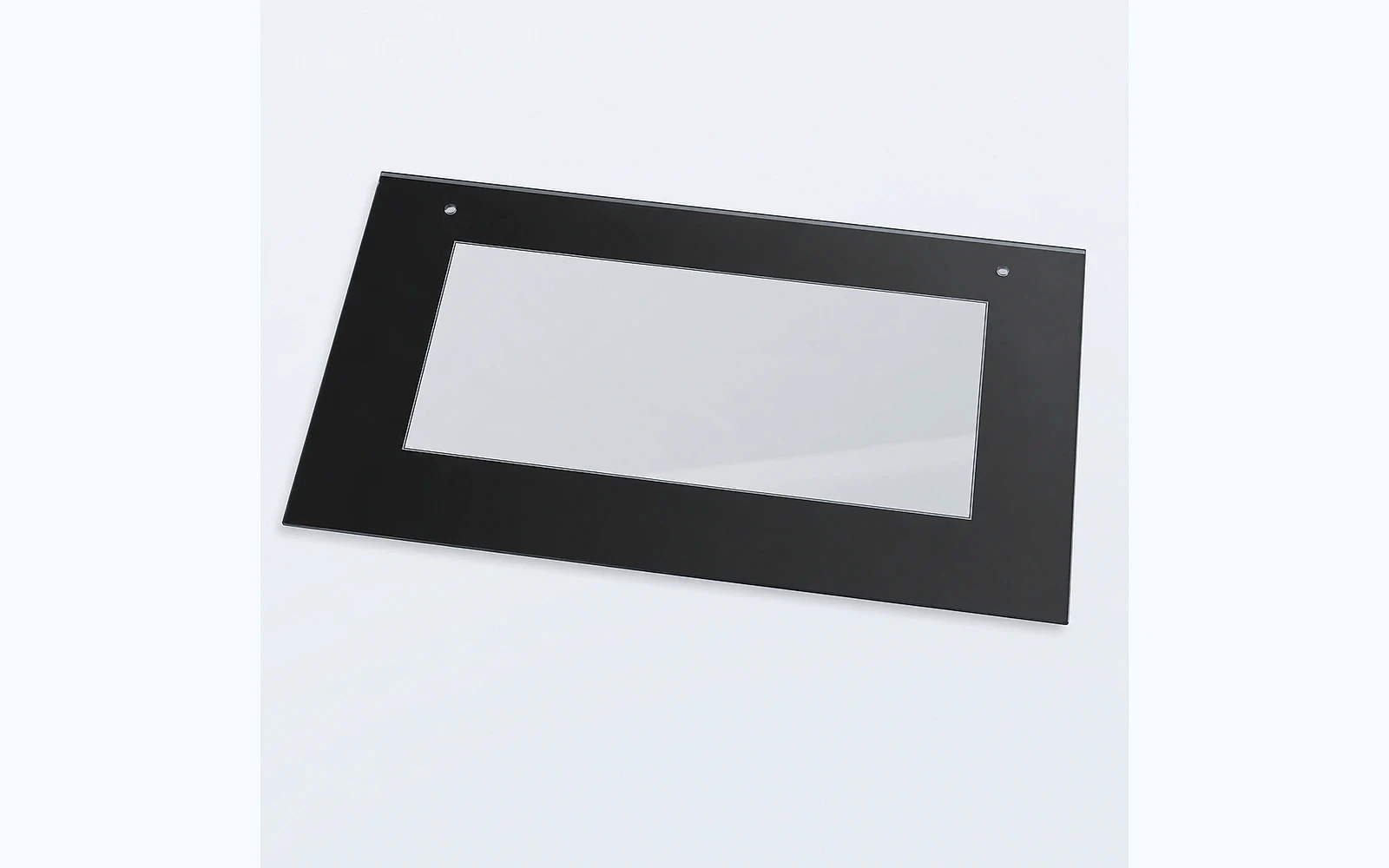




Quick answer: Low-E glass manages radiative heat, but the complete oven door determines performance
Low-emissivity, or Low-E, coated oven door glass uses a thin functional layer to reduce thermal radiation across a selected infrared range. In a correctly designed multi-pane door, this can support a lower outer-surface temperature, reduced heat transfer to adjacent components, or improved thermal efficiency. The coating is not a stand-alone guarantee: glass composition, pane spacing, coating side, ventilation, frame geometry, seals, printing, oven cavity temperature and installation preparation all affect the result.
An OEM should specify the required outcome at assembly level, then define measurable component controls. These normally include spectral or emissivity characteristics, visible transmission and reflection, color, coating orientation, coating durability, edge deletion if required, print compatibility, flatness, cleanliness and traceability. Prototype doors should be tested in representative powered conditions before production release.
The official scope of ISO 20589:2025 concerns emissivity measurement of building glass near room temperature and includes material limitations. ASTM E408-13(2025) covers total normal emittance measurement and notes additional care for semi-transparent specimens. These references may inform a measurement plan, but neither automatically proves that an oven door meets its product safety or thermal-performance requirements.
What Low-E means on an oven glass panel
Every surface emits thermal radiation. Emissivity describes how effectively a surface emits energy compared with an ideal blackbody under defined conditions. A Low-E layer is engineered to have lower infrared emissivity than an untreated glass surface over a relevant wavelength range.
This distinction matters because an oven door transfers heat by three interacting mechanisms:
- radiation between hot internal surfaces and glass panes;
- conduction through glass, spacers, frames and seals;
- convection through enclosed or ventilated air spaces.
The coating primarily changes the radiative path. It does not remove conduction through brackets or convection through an incorrectly ventilated gap. A supplier should therefore avoid promising a specific outer-door temperature from a glass coupon alone.
Start with the required product outcome
The RFQ should state what the coating must help the appliance achieve. Useful objectives include:
- an outer-door surface-temperature limit under a defined cooking cycle;
- reduced heat load on a display, touch sensor, adhesive or decorative fascia;
- lower heat loss through the door system;
- controlled powered-off appearance and visible reflection;
- adequate viewing-window transmission when the cavity lamp is on;
- stable performance after cleaning, humidity and thermal cycling.
The target must include test conditions: ambient temperature, oven mode and set point, duration, rack load, measurement locations, thermocouple attachment, stabilization rule and pass/fail criteria. Without those details, two suppliers can report different “temperature improvements” that are not comparable.
Choose the coating position as part of the door stack
A multi-pane oven door has several numbered surfaces. The same coating can behave differently depending on whether it faces a sealed cavity, an air channel, a printed surface or the user side. Orientation also changes the risk of contact, cleaning and handling damage.
During stack-up review, document:
- the inner, middle and outer pane materials and thicknesses;
- surface numbering from cavity side to room side;
- exact Low-E surface and coated-face direction;
- ceramic print, organic print, masking and viewing-window locations;
- gaps, spacers, vents, seals and frame contact points;
- adhesive or gasket chemistry near the coating;
- the side exposed to cleaning or assembly handling.
Do not leave coating orientation to an assembly operator’s interpretation. Use drawing notes, asymmetric identification features, protective-film labels and incoming inspection to prevent reversal.
Define optical and thermal properties separately
“Low-E” is not a complete material specification. A useful datasheet distinguishes the variables below.
| Property | Why it matters | How to control it |
|---|---|---|
| Emissivity or emittance | relates to radiative heat transfer | agreed method, surface, wavelength basis and conditioning |
| Visible transmission | affects view into the cavity | defined illuminant, observer and aperture |
| Visible reflection | affects premium mirror-like appearance | measure coated and uncoated side as relevant |
| Color coordinates | controls neutral, blue, bronze or grey appearance | instrument geometry and approved master |
| Haze | affects clarity through the viewing area | clean sample, specified background and method |
| Sheet resistance, if relevant | can be a process proxy for some conductive coatings | calibrated four-point or approved contact method |
An electrical resistance value cannot replace optical and thermal verification unless the customer has established a validated correlation for that exact coating system. Likewise, visible reflection alone does not prove low emissivity.
Select a measurement method that fits the actual coating
Measurement references have boundaries. ISO 20589:2025 is written for flat, non-diffusing building-glass products and excludes materials that are infrared-transparent in the relevant spectral region. ASTM C1371-15(2022) uses portable emissometers for suitable opaque, highly thermally conductive materials near room temperature; its official description cautions against highly anisotropic or infrared-transparent specimens. ASTM E408 includes techniques for total normal emittance and warns that semi-transparent samples can introduce additional error.
For an appliance project, agree:
- whether the reported value is normal emittance, hemispherical emissivity or a supplier-specific proxy;
- the instrument, calibration reference and sample conditioning;
- which face is measured;
- measurement locations and number of readings;
- temperature range and whether room-temperature data are being used only for incoming control;
- the relationship, if any, between coupon data and hot-door performance;
- rounding, guard bands and measurement uncertainty.
If the coating operates at elevated temperature, a room-temperature instrument value should be treated as a controlled material characteristic—not automatically as the value used in a thermal model.
Account for printing and decoration
Oven glass commonly combines a Low-E layer with a black ceramic border, dot gradient, icons or a display window. The process order and overlap rules require engineering review. Potential interactions include:
- coating damage or color shift during thermal processing;
- reduced ink adhesion on a coated face;
- a visible boundary where coating is deleted;
- optical mismatch between printed and clear areas;
- pinholes or light leakage near a display window;
- altered heat absorption during tempering;
- color variation caused by backing material or air gap.
The approved appearance master should represent production-intent glass, coating, printing, backing and illumination. A loose glass sample on a white table is insufficient for approving the installed appearance.
Engineer the edge and contact zones
Some coatings require edge deletion so that adhesives, seals or electrical contacts bond to a suitable substrate. Other systems may allow bonding over the coating, but only after compatibility and durability testing. Define the deletion width, position tolerance, transition appearance and inspection method on the drawing.
Keep hard metal parts away from glass edges and coated surfaces. Provide compliant pads, controlled clamp loads and adequate clearance for thermal expansion. If a coating wraps toward an edge, packaging separators and assembly fixtures must not rub it.
Validate coating durability for the real use case
A Low-E result at incoming inspection says little about durability unless the exposed surface and service environment are known. A validation matrix may include:
- dry and damp heat exposure;
- thermal cycling representative of cooking and cooling;
- approved household-cleaner contact;
- abrasion from specified cloths or assembly handling;
- adhesion or tape checks where applicable;
- condensation exposure;
- visual, optical and electrical comparison before and after testing.
Set the acceptance criteria before testing. Record color difference, haze, transmission, reflection, resistance or emissivity as relevant, plus visible defects such as staining, iridescence, peeling, scratches or edge corrosion. Do not convert an accelerated exposure into an unsupported lifetime claim.
Test the complete oven door
Component data supports engineering, but the release decision belongs to the product assembly. A practical validation ladder is:
Material coupons
Confirm the selected coating family and establish baseline optical and emissivity data.
Finished glass panels
Verify tempering, flatness, printing, coating uniformity, edge quality and critical dimensions on the actual geometry.
Prototype door assembly
Install production-intent spacers, seals, vents, fasteners and neighboring components. Confirm assembly sequence and coating orientation.
Powered appliance test
Run the released operating modes and measure defined points over time. Review user-touch surfaces, handle, fascia, display, adhesive and internal components.
Reliability and misuse conditions
Apply the product team’s applicable thermal cycles, door operations, cleaning and abnormal-use evaluations. The relevant product standard and market requirements must be selected by the OEM’s compliance team.
This sequence separates material qualification from appliance validation and makes failures easier to diagnose.
Control factory production without over-testing
Mass production needs a practical control plan rather than repeating every qualification test on every panel. Typical controls include:
- approved coating source and batch identification;
- substrate, thickness and coated-side verification;
- incoming optical or electrical proxy checks where validated;
- controlled storage, humidity and shelf-life rules;
- cutting and edge-processing protections;
- print and tempering recipe change control;
- coating-side identification through each operation;
- cosmetic inspection under fixed lighting;
- periodic full-property verification;
- finished-panel traceability to coating and process lots.
The control frequency should reflect customer requirements, process capability and risk. Any change in coating supplier, layer stack, substrate, furnace route, ink, cleaning chemistry or measurement instrument should trigger documented review.
Plan shipment inspection and packaging
Coated glass can leave the factory within specification and arrive damaged if separators or films interact with the surface. The packaging release should verify:
- clean, non-abrasive and non-reactive interleaving;
- no adhesive contact with a sensitive coated face unless approved;
- edge and corner protection;
- panel orientation and quantity per pack;
- moisture protection appropriate to the route;
- labels that identify coated side without exposing confidential design data;
- a shipment inspection record tied to part revision and lot.
Run a transport trial when the panel is large, the coating is delicate or the route is long. Inspect the first unpacked layers and internal positions rather than only the top panel.
Supplier evidence buyers should request
Ask for evidence that answers the decision, not a generic brochure:
- coating designation and approved source;
- controlled property ranges and methods;
- measurement-system verification or calibration status;
- coated-side and orientation controls;
- compatibility results for the released ink, seal and cleaner;
- production-intent thermal-door test report owned by the OEM or integrator;
- change-notification rules;
- lot traceability and certificate/report format;
- packaging specification and shipment-release checklist.
Commercial confidentiality may limit disclosure of layer chemistry or furnace recipes. That is acceptable if the supplier can still provide auditable property, traceability and change-control evidence.
RFQ checklist for Low-E oven door glass
Send the supplier:
- 2D drawing, 3D data and revision;
- product application and target markets;
- complete door cross-section with surface numbering;
- material, thickness, strengthening and edgework;
- coating function, face and measurable property limits;
- artwork, color masters and optical-window requirements;
- bonding, gasket and frame interfaces;
- thermal duty cycle and assembly-level acceptance criteria;
- approved cleaners and durability exposures;
- cosmetic zones and inspection lighting;
- documentation, sample quantity and schedule;
- packing, labeling and shipment requirements.
Ask the processor to list assumptions, exceptions and outsourced operations before quotation. This prevents a decorative reflective coating from being quoted as though it were a qualified thermal-control layer.
FAQ
Does Low-E oven glass always reduce the outer-door temperature?
It can reduce radiative heat transfer, but the magnitude depends on the complete door. Pane spacing, vents, frames, seals, coating orientation and operating cycle must be validated in a production-intent assembly.
Can visible reflectivity be used as proof of low emissivity?
No. A reflective appearance may come from several coating types. The project needs a defined emissivity or emittance measurement and a separate visible optical specification.
Which side should the Low-E coating face?
There is no universal answer for every layer stack. The coating supplier and door engineer should select a surface based on thermal modeling, environmental exposure, printing, cleaning and assembly risk, then lock it on the drawing.
Can an emissivity standard for building glass certify an oven door?
No. It may provide a useful material measurement method within its scope, but appliance safety and performance require the applicable product requirements and complete-door validation.
What should be checked after cleaning or thermal cycling?
Recheck the controlled thermal or proxy property, visible transmission, reflection, color, haze and appearance. Also inspect for staining, peeling, edge corrosion, scratches and print/coating interaction.
Conclusion
Low-E coated oven door glass is a system-engineering component, not a label that guarantees a cool door. A reliable sourcing program defines the assembly outcome, coating surface, measurable properties, printing and bonding interfaces, durability plan, production controls and shipment protection. The OEM then validates the complete door under representative powered conditions and maintains change control through production.
For a technical review, send Tairong your oven door drawing, layer stack and thermal target. Related resources cover custom oven door glass specification, functional appliance-glass coatings, thermal-shock validation and our oven glass capabilities.